
Clatsop Release Sources for BOP
When a federal search begins with a local booking, first check the Clatsop jail report, request the actual handoff through Clatsop Sheriff Records, and compare any local disposition on the Clatsop Circuit Court records page. Those sources prevent a local disappearance from being mislabeled as a federal release.
BOP becomes the correct locator only after a federal sentence or federal identifier supports that path. The federal docket then explains the judgment and later supervision.
Federal Prison Release Outcomes
BOP operates and uses federal prisons and contract facilities across the nation. It applies to sentenced federal prisoners, not ordinary Clatsop County jail cases. A federal defendant may have a connection to Clatsop County through residence, arrest, court activity, or temporary detention without ever becoming an ODOC prisoner.
After BOP custody, a person may enter the community under federal supervised release, move to another sovereign's custody, or reach another lawful placement. The federal judgment states the sentence and supervised-release term. The BOP locator records the status represented in BOP's database. These sources should be paired when the exact outcome matters.
Confirm a Federal Prison Release
Start at the official BOP Inmate Locator. Search by BOP register number when known because it avoids same-name errors. Other accepted identifiers include DCDC, FBI, and INS numbers. A name search can use demographic fields to narrow results.
- Identify the federal case. Verify that the judgment imposed a federal sentence.
- Search the locator. Prefer the register number and compare every displayed identifier.
- Read the exact result. Record the facility, location wording, release date, and date checked.
- Open the federal docket. Review the judgment and later orders for supervised release or custody changes.
- Request the movement record. Use BOP FOIA or Privacy Act procedures when exact release documentation is needed.
A county-only search belongs in the Clatsop County release records guide, not the federal locator.
Federal Prison Records Contact
This page covers a nationwide system, so there is no truthful Clatsop County BOP facility contact card. No BOP institution was identified in the county. Use the institution displayed in a current result for present facility questions, and use BOP's central records procedures for historical movement or release material.
Nationwide sentenced-prisoner system
Public search: BOP Inmate Locator
Historical records: BOP FOIA/Privacy Act route
No BOP prison is located in Clatsop County.
The BOP locator records explanation defines its coverage and status terms. Privacy rules affect access to a living person's detailed file. Give the register number, full name, birth date, institution, and approximate movement or release dates when requesting records.
Federal Release Result Meanings
BOP says its locator covers federal custody from 1982 forward and updates daily. Former-prisoner results commonly show a release date. A past Release Date with no facility, or a Location of RELEASED, means the person is no longer in BOP custody as represented by that database. Older records may require the National Archives.
| BOP wording | Careful interpretation |
|---|---|
| RELEASED | No longer in BOP custody in the locator record; check supervision or another custodian separately |
| Past release date | BOP release event shown for the federal term |
| Future release date | Projected date, not proof the event occurred |
| IN TRANSIT | Movement within federal custody, not release |
| UNKNOWN | Does not establish community release |
| Not in BOP custody | Outside BOP physical custody, with other legal statuses still possible |
Save the result date. A federal release date can reflect statutory sentence calculations and later updates. The exact federal docket and BOP record should control over an undated copy.
Federal Custody Status Limits
“Not in BOP custody” is narrower than “free of all legal control.” A person may be on supervised release, held by another jurisdiction, moved under a writ, or placed outside a BOP institution. Federal Probation and Pretrial Services context or the court docket may explain the next stage, though public access to supervision details can be limited.
BOP also does not replace USMS for federal pretrial custody. The Marshals Service manages detainees during court proceedings and may use contract jail beds. Such a person can be physically housed near a county facility without becoming a sentenced BOP prisoner. A no-result in BOP during that stage proves little.
ICE detention is separate civil immigration custody. Its Online Detainee Locator uses different identifiers and rules. Do not treat a BOP release followed by an ICE transfer as unrestricted community release unless the records support that conclusion.
Federal Court Release Records
The federal docket supplies the judgment, sentence, supervised-release terms, later revocation proceedings, and court orders. PACER is the official federal court records system. CourtListener may help locate publicly collected docket material, but the official docket and filed order should be checked when precision matters.
A release date in BOP does not alone describe the terms that follow. Federal supervised release is a court-ordered term after imprisonment. It is not the same as Oregon parole, Clatsop probation, or ODOC post-prison supervision. The federal judgment identifies its length and core legal authority.
When a result conflicts with another source, compare identifiers and dates first. People can share names, and a new case can follow an older release. The register number and federal case number are the strongest links between the locator, institution record, and court file.
Read the Federal Locator
The official BOP search interface shows the identifiers and name fields used for a nationwide query. Its source is the right visual reference for a federal release search tied to Clatsop County.
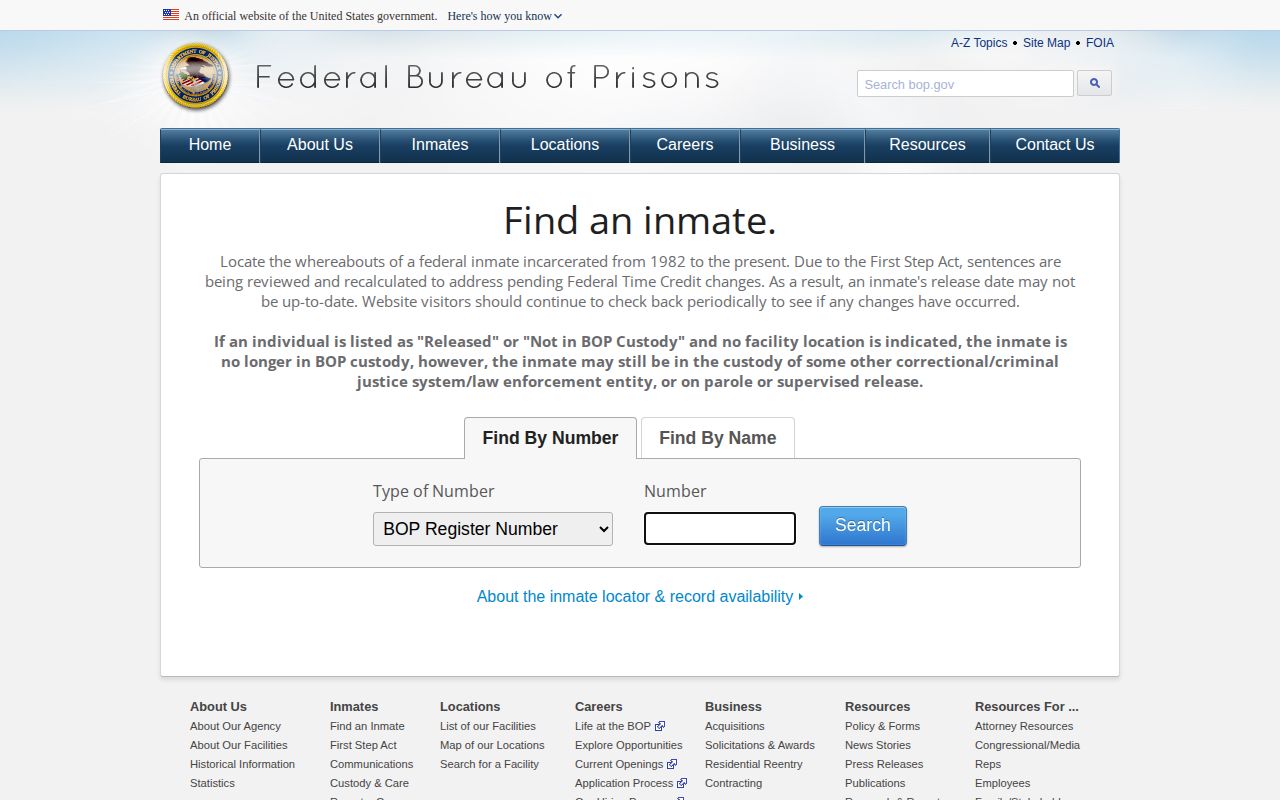
The captured interface reinforces that BOP searches need federal identifiers or federal case context and do not serve as a substitute for the Clatsop jail roster.
Request Federal Release Records
Ask for a defined BOP record, such as the admission and release chronology or movement history for a known register number. State the approximate dates and institution. The Privacy Act can limit third-party access to a living person's records, and BOP may redact protected content under federal law.
If the locator is old or incomplete, identify whether the record predates 1982. Historical federal inmate files may be held by the National Archives rather than BOP. Keep the federal case number with the request so the judgment can be compared with the custody record.
The proof chain is straightforward: the federal judgment establishes the sentence, the BOP locator supplies the public status, and the BOP file documents the actual custody movement. Other custody systems should be checked only when the evidence points to them.
Clatsop Federal Release Verification
A Clatsop connection can arise without county custody controlling the case. A federal defendant might live in the county, be arrested nearby, appear under a writ, or spend time in a contract bed. Begin with the court and agency named in the source. Do not move from a local place name to BOP unless a federal judgment or register number supports it.
Preserve the BOP result with the register number and check date. Coverage begins in 1982 and updates daily. Older records may belong at the National Archives. For a recent result, compare the date with the judgment and any revocation or amended order. One term can end while another case continues.
Federal supervised release is imposed by the court after prison. It differs from Oregon parole, ODOC post-prison supervision, and Clatsop probation. BOP can show that its physical custody ended, while the docket shows the court-ordered term that follows. Public access to operational supervision facts may be limited.
If the person transferred to state, local, immigration, or Marshals custody, use that system next. “Not in BOP custody” cannot identify the next authority alone. A precise conclusion says what the locator proves, names any documented receiver, and gives the source date.
Verify the Federal Release Record
Build the federal timeline with the case number, judgment, register number, institutions, release date, and later docket activity. Check whether the displayed date is past or future and whether the location says RELEASED, IN TRANSIT, or UNKNOWN. Only RELEASED or a past date with no facility supports the BOP conclusion described by the agency.
Then ask whether another source documents supervised release or a receiving custodian. The answer may require the docket, USMS, ICE, or a state agency. Keep conclusions limited to each system. The BOP file can prove its movement; the federal court can prove the sentence and supervision order; another agency must prove its own later custody.
Recheck the official source before relying on the timeline. Custody, supervision, court orders, contact details, and public database coverage can change. Save stable identifiers and the date of every observation. When two records differ, ask the agency that created the disputed field for clarification and preserve its written response. State only the event that the evidence supports, and distinguish a physical move, transfer, supervised placement, projected date, release, and final discharge.
Public Record Search
Sponsored Results